Find out where your money went.
Our developers built EFBS Trace — a search engine that works with our team to follow a loss through blockchains, SWIFT routes, and transfer records, and estimate how much of it is still traceable and where it ended up.
An estimate of funds and location. Not a recovery, and not a promise of one.
- About two minutes
- No fee for the first assessment
- Report to the authorities that matter
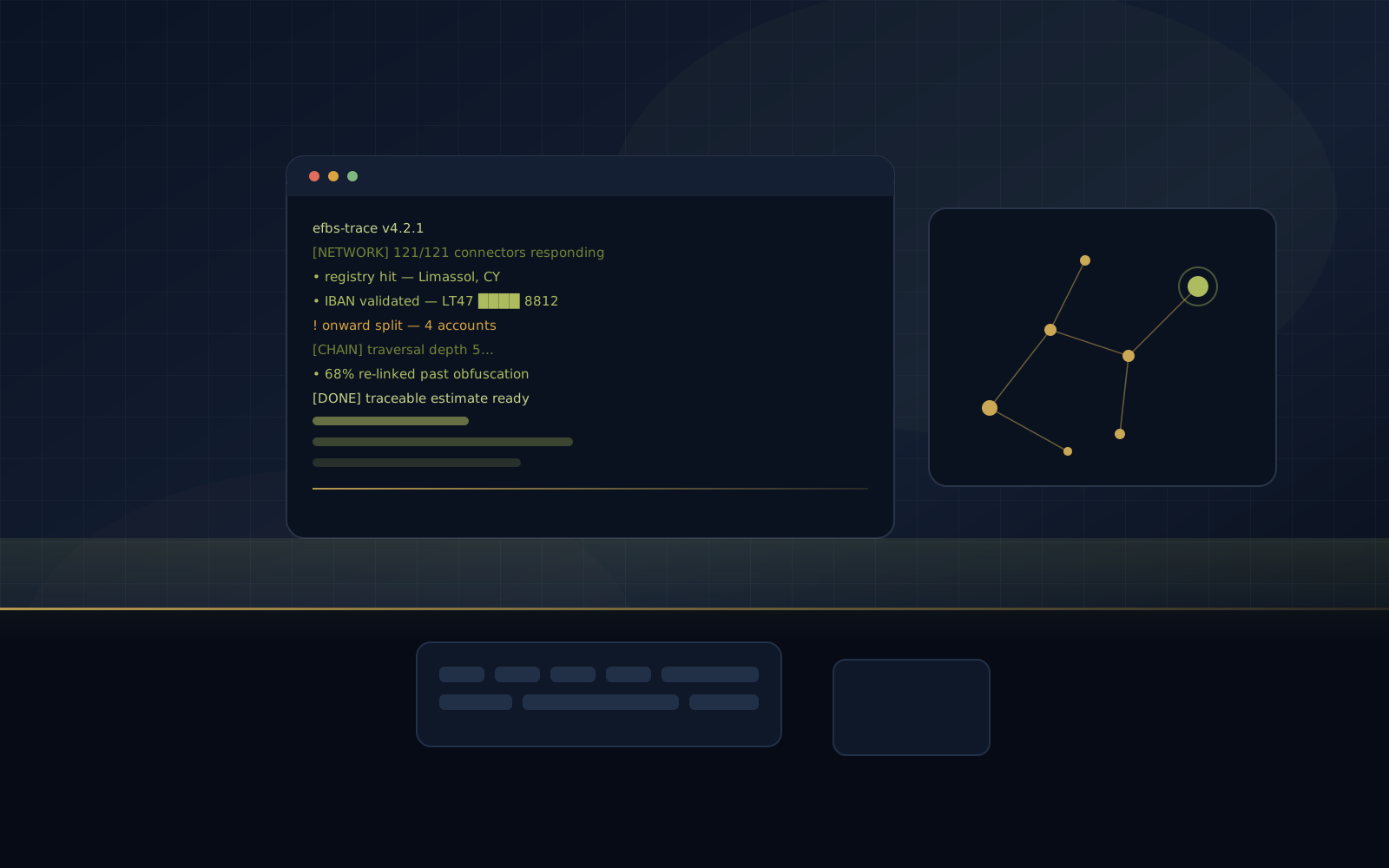
efbs-trace · sample run
illustrative excerpt · every trace differs
EFBS Trace
A search engine for a loss.
You tell it what happened. It matches your report against our own case data and against data available across our partner network and the open internet, then follows the money as far as the evidence allows.
Blockchain analysis
Address clustering, hop-by-hop traversal, mixer and bridge detection, and identification of the exchange deposit addresses where a chain of transfers finally meets a KYC record.
BTC · ETH · TRON · BSC · SOL · Polygon
Correspondent banking
SWIFT/BIC routing, IBAN validation and institution resolution, and reconstruction of the correspondent chain a wire actually travelled — not just the account you were told to pay.
SWIFT · SEPA · IBAN · Faster Payments
Entity resolution
Matching the names, phone numbers, domains, and company registrations in your evidence against corporate registries and our own case history to identify who is behind a front.
Registries · WHOIS · Filings
Agency cross-check
Every entity we surface is checked against the sanctions lists, watchlists, and prior-report data shared through our agency network.
121 sources
What you get at the end
An estimated amount
How much of your reported loss still appears to sit somewhere identifiable — as a range, with a confidence figure attached.
A location
The jurisdictions the traced value moved through, and where it appears to have come to rest.
The account type
Whether the traced portion is held in bank accounts, wallets, or a mix — which decides what legal routes exist.
Who is attached to it
How many people and companies the trace surfaced, what role each appears to play, and what flags sit against them.
How known they already are
How many existing reports across the network name the same platform or person, and how many people it has affected.
A reporting package
Report drafts prepared for the relevant authorities, filed only if you tell us to.
You describe what happened
Six questions, one at a time. Name, how you lost the funds, who or what you paid, how much, when, and where to send the result. It takes about two minutes.
EFBS Trace runs
Your report is normalised and matched against our own case data and against sources across the agency network. You watch the trace happen — every query, hop, and match is shown live rather than hidden behind a progress bar.
You get an estimate
How much of the loss appears to still be traceable, where it moved to, what kind of accounts hold it, and which entities are attached to it. An estimate, with a confidence figure attached — never a promise.
A lawyer picks it up
The trace is a starting point, not a case. One of our agents goes through the findings with you and tells you honestly whether there is a route worth pursuing.
Be clear on the limits. EFBS Trace estimates what is traceable. Traceable is not the same as recoverable, and no trace — ours or anyone’s — can promise your money comes back. What it does is tell you whether there is anything worth pursuing before you spend money finding out.
Run a trace nowIf it just happened
Do these four things first.
They cost nothing, they take about twenty minutes, and they materially change what is still recoverable. Do them even if you never contact us.
- 1
Stop sending money
Including to anyone offering to recover what you already lost. Follow-on recovery fraud is one of the most common second hits.
- 2
Tell your bank today
Ask them to raise a recall on every transfer and to record the date and time you reported it. Get a reference number.
- 3
Save everything before it disappears
Screenshot chats, profiles, websites, and transaction confirmations. Export rather than screenshot where you can.
- 4
Run a trace
Six questions, about two minutes. You get an estimate of how much appears to still be traceable and where it went — before you spend anything on lawyers.
The network
121 authorities and agencies.
We collect and cross-check data in cooperation with 121 authorities and agencies — national police cybercrime units, financial intelligence units, banking regulators, sanctions bodies, and industry reporting schemes. That network is what turns a scattered set of receipts into a picture of where funds actually went.

Police and cybercrime units
National and regional forces with dedicated economic-crime or cyber divisions, plus the multi-country coordination bodies they report into.
Financial intelligence units
The bodies that receive suspicious activity reports. Where a receiving account has already been flagged, that changes what is realistically recoverable.
Regulators and supervisors
Banking, securities, and virtual-asset supervisors. Useful for establishing whether a “platform” was ever licensed anywhere, and for complaints where a regulated firm failed its own controls.
Sanctions and watchlist bodies
Consolidated sanctions lists and law-enforcement watchlists, checked against every entity and address the trace surfaces.
Reporting and victim-support schemes
National fraud reporting centres and consumer bodies. These are also where we help clients file, so the case exists on the record.
Reporting
Most online fraud is never reported to anyone who can act on it.
People report to their bank, hear nothing, and stop. Or they file with one national portal and the case sits in a queue with no connection to the twelve other reports naming the same platform.
We use the trace to work out which bodies actually have jurisdiction over your specific case — the police unit where the receiving account sits, the financial intelligence unit that already holds reports on it, the regulator that never licensed the platform — and we prepare the filings for each of them in the format they accept.
You decide which ones go out. Nothing is submitted on your behalf without your authorisation, and you get a copy of everything filed.
- Reports built from evidence, not a web form
- Filed in the jurisdiction that can actually act
- Linked to existing reports naming the same operation
- You keep a copy of every submission

What we do
Two things, properly, rather than everything badly.
Our practice is built around online financial crime and data protection. Where a matter needs expertise we do not have, we will tell you and point you somewhere better.
Online Fraud & Scam Recovery
Tracing where your money went, identifying who holds it, and using civil and regulatory routes to try to get it back.
What this involvesInvestment & Crypto Fraud
Fake trading platforms, long-con relationship investment schemes, rug pulls, and the bogus recovery services that target victims a second time.
What this involvesBusiness Email Compromise & Payment Diversion
When an invoice was intercepted and a payment went to the wrong account — for the company that paid, or the one that never got paid.
What this involvesData Breach Response
Legally-led incident response: containment advice, regulator notification, and defending what follows.
What this involvesPrivacy & Data Rights Enforcement
Enforcing your rights over your own data — access, erasure, delisting — and pursuing compensation where they were ignored.
What this involvesAccount Takeover & Identity Theft
Regaining control of hijacked accounts, unwinding fraudulent credit, and clearing your name of someone else's activity.
What this involvesTeam + AI
The machine reads. The lawyer decides.
Online crime cases drown in material — chat histories running to tens of thousands of messages, transaction exports, server logs, disclosure from three different banks. Reviewing that by hand is slow and expensive, and clients end up paying for reading rather than for thinking.
EFBS Trace does the reading. It builds the timeline, clusters the addresses, and flags the contradictions. Then a qualified lawyer checks the work and decides what it means and what to do — because that part is not something you can delegate to software, and we are the ones who answer for it.
A lawyer is accountable for everything
Every document, filing, and piece of advice is reviewed and signed off by a qualified lawyer. AI output is a draft or a lead, never a decision.
Machines for volume, people for judgement
AI is good at reading ten thousand transactions and finding the ninety that matter. It is not good at deciding what to do about them. We use each for what it is actually good at.
Confidentiality is not negotiable
Client material is handled under controls appropriate to privileged information. We document what is processed where, and you can ask us for that documentation at any time.
You can opt out
If you would rather your matter were handled without AI-assisted processing, say so. It may cost more and take longer, and we will tell you by how much.
It is not a discount on care
We use these tools to spend more time on your case, not less. Efficiency shows up as a faster response and a cheaper investigation — not as a thinner service.
How it works
You will always know what happens next.
No open-ended retainers and no invoice you were not warned about. Here is the whole sequence.
01 · Usually within one working day
Free initial assessment
A conversation with a lawyer, not a sales script. We establish what happened, what evidence exists, and whether there is a realistic route forward. If there is not, we say so and you owe us nothing.
02 · Hours, not weeks
Preserve and stabilise
Before anything else: secure the evidence, notify the institutions that need notifying, and stop the situation getting worse. Notice letters and preservation requests often go out the same day.
03 · Days to weeks, depending on complexity
Investigate
Reconstruct the payment or intrusion chain, identify counterparties and intermediaries, and establish which jurisdictions are in play. This is where our AI tooling does the heaviest lifting — and where a lawyer checks every conclusion it reaches.
04 · Before any chargeable work begins
Strategy and written proposal
You get a plain-language assessment: the routes available, what each is likely to achieve, what each will cost, and what we recommend. You decide what to authorise.
05 · Ongoing, with scheduled updates
Execute
Freezing and disclosure applications, complaints and regulator submissions, negotiation, or proceedings. One named lawyer stays responsible for your matter throughout.
A warning worth more than our marketing
If someone contacted you offering to recover your money, it is probably a second fraud.
Victim lists get resold. People who have already lost money are the most valuable targets there are, and a whole industry exists to hit them again. Before you engage anyone — us included — check these:
- They contacted you first, out of the blue. Legitimate firms do not cold-call fraud victims.
- They want an upfront fee to release, unlock, or convert funds. No real process works that way.
- They cannot be found on a public bar or regulator register under the name they gave you.
- They guarantee recovery, or quote a percentage they are certain of. Nobody can know that.
Verify us the same way you should verify anyone else: our registration details are in the footer of every page, and you can confirm them with the regulator directly rather than through any link we give you.
Straight answers
The questions people actually ask us.
Can you guarantee you will get my money back?
No, and neither can anyone else. Any firm that promises recovery is telling you something they cannot know. What we can do is assess your case honestly, tell you what the realistic range of outcomes looks like, and act fast enough to preserve the options that still exist.
How quickly should I contact you?
Immediately. In fraud matters, funds are typically moved onward within days, and freezing options narrow sharply after that. In breach matters, statutory notification clocks usually start when you become aware of the incident, not when you finish investigating it.
What does it cost?
The first assessment is free and carries no obligation. After that we will give you a written fee proposal before any chargeable work starts. Depending on the matter we may offer fixed fees, hourly rates, or — where the case supports it and local rules permit — a conditional arrangement. You will never receive an invoice you were not warned about.
How exactly do you use AI?
For volume work: sorting transaction records, timelining chat logs, clustering wallet addresses, comparing document sets, and first-pass research. A qualified lawyer reviews every output and signs off on all advice and filings. AI does not make decisions about your case, and it does not replace anyone on the team.
Is my information kept confidential if I use AI tools?
Confidentiality obligations apply to your matter regardless of the tools involved. See our Technology & AI page for exactly which categories of data go where, and the controls we apply. If you would prefer we handle your matter without AI-assisted processing, tell us and we will.
Do I still need to report this to the police?
In most cases yes, and we will help you prepare a report investigators can actually use. A criminal report and a civil recovery claim run in parallel — one does not replace the other, and the criminal process rarely returns your money on its own.
More on how we work and how we use AI.
Time is the variable you control.
In fraud matters funds move within days, and in breach matters notification clocks start the moment you become aware. Running a trace takes about two minutes and costs nothing.